
A former MTSU lecturer and Murfreesboro poet laureate is building software that helps people find words for their hardest experiences, with early support from the Wond'ry and the Mid-South Hub I-Corps programming
Matthew Leavitt Brown has spent more than twenty years helping people put words to their pain. The conviction behind that work is simple. “The way you describe something often replaces the thing you are describing,” mused Brown. “And so having intention in that changes everything.” That belief now drives Lingwell, a software platform that guides users through their own thoughts to help them name difficult experiences and complex emotional states.
The idea grew out of Brown's own experiences, as well as his extensive time listening to others express their trauma. He grew up in rural Southern Illinois, where many of the people he knew enlisted into military service, hoping to pay their way to college. Many were deployed to active war zones. "I had this kind of survivor's guilt," Brown said. "I became a poet because I got scholarships, and they went to war."
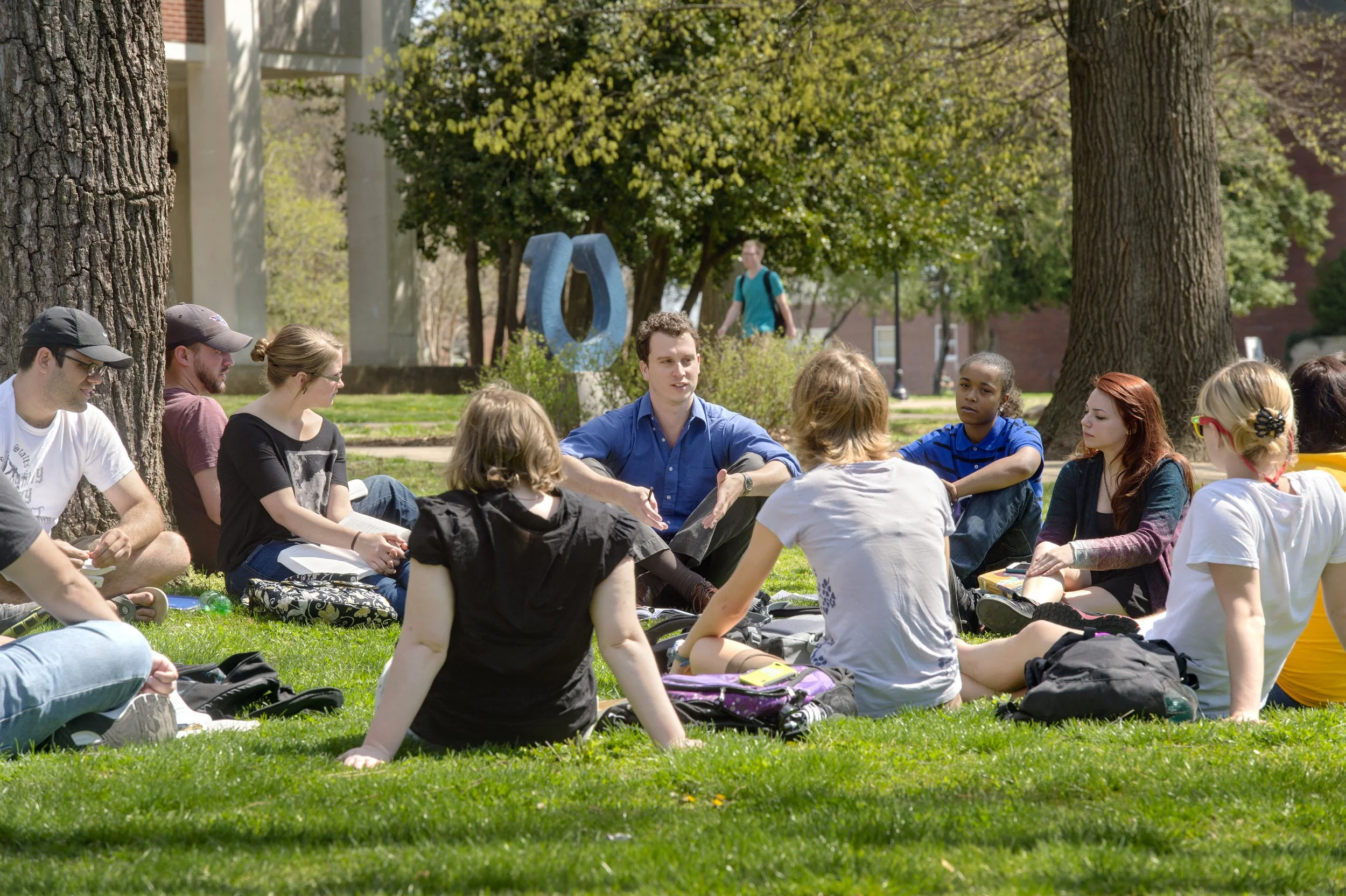
Matt teaching outside at Middle Tennessee State University
Years later, while teaching at MTSU, he watched veterans arrive in his classroom only days after leaving Baghdad. He started a writing group to help them tell their stories, and its success led him to a Ph.D. in language studies focused on intentional language as a therapeutic tool after trauma. Over the next decade, he brought the same approach to domestic violence shelters, prisons, refugee communities and hospital rooms. The settings changed, but his method did not. “It’s the same thing happening internally,” Brown said. “It’s just a different stimulus causing it.”
That work experienced a dramatic shift during the rise of COVID-19, with Brown contracting the illness and dealing with long-term autoimmune complications. A severe flare-up in 2024 ended his in-person group work. While studying AI to stretch his efforts, he realized a language model could carry the practice he had spent years refining. “Everything I know about structural language and cognition would apply,” he said.
In Lingwell, a user talks through an experience and then receives a concise summary that they can then edit and refine. Once it fits, the summary can be saved like a journal entry or shared with doctors or therapists. Pathways include pre-appointment preparation, end-of-shift debriefs built with ER nurses, grief support and recovery support. “Every part of our systems and institutions says you have to be your own best advocate, but they don’t help you do that,” said Brown.
He never planned to start a business. Turning a mission into a company required what he calls an existential adjustment. The Wond'ry, Vanderbilt’s Innovation Center, and the NSF Mid-South Hub I-Corps programming helped him make it. He entered the Sullivan Family Ideator Program in the summer of 2024 with his nonprofit concept, then returned with the Lingwell idea and moved into the Builder Program. He used the program's discovery process to test a new direction and to build out a prototype app. “It was hell on earth, but I figured it out, and it taught me a lot,” Brown said. “One of my favorite things about Matthew is that he prefers the title ‘steward’ over ‘founder,’” said Mark Hilton, Hub Technology Scout Lead. “His desire to ease the suffering of others has always been central to who he is, and I’ve watched him grow from someone with a powerful vision into an entrepreneur capable of bringing that vision to life. Through his ‘existential adjustment,’ I’ve watched him identify potential customers, build his MVP, and develop a financially sustainable business model. Coaching him through that process has been one of the greatest privileges of my career. Having seen firsthand what Matthew is capable of, I have every confidence in his ability to turn his vision into meaningful, lasting impact.”
Along the way, Brown has come to see entrepreneurship as a kind of translation, a new language for the same work. He wants growth to widen Lingwell's reach rather than its margins. “Make the tent bigger, not the stake higher,” he said. After 20 years in the classroom, Brown stepped away from teaching this fall to focus on Lingwell full time. “To me, the mission is constant, so everything else can move around it,” he said.
To learn more about Lingwell, go to https://www.lingwellhealth.com/.