
David Lockett Wins First Prize at HBCU Founders Initiative Demo Day for Drone Safety Invention AeroSense
NASHVILLE, TN — David Lockett, PhD data science student and grants proposal development specialist at Meharry Medical College's School of Applied Computational Sciences (SACS), has been named the first-prize winner of the HBCU Founders Initiative (HBCUFI) Demo Day competition. His venture AeroSense was recognized for its life-saving potential and awarded $2,500 in funding plus product development support.
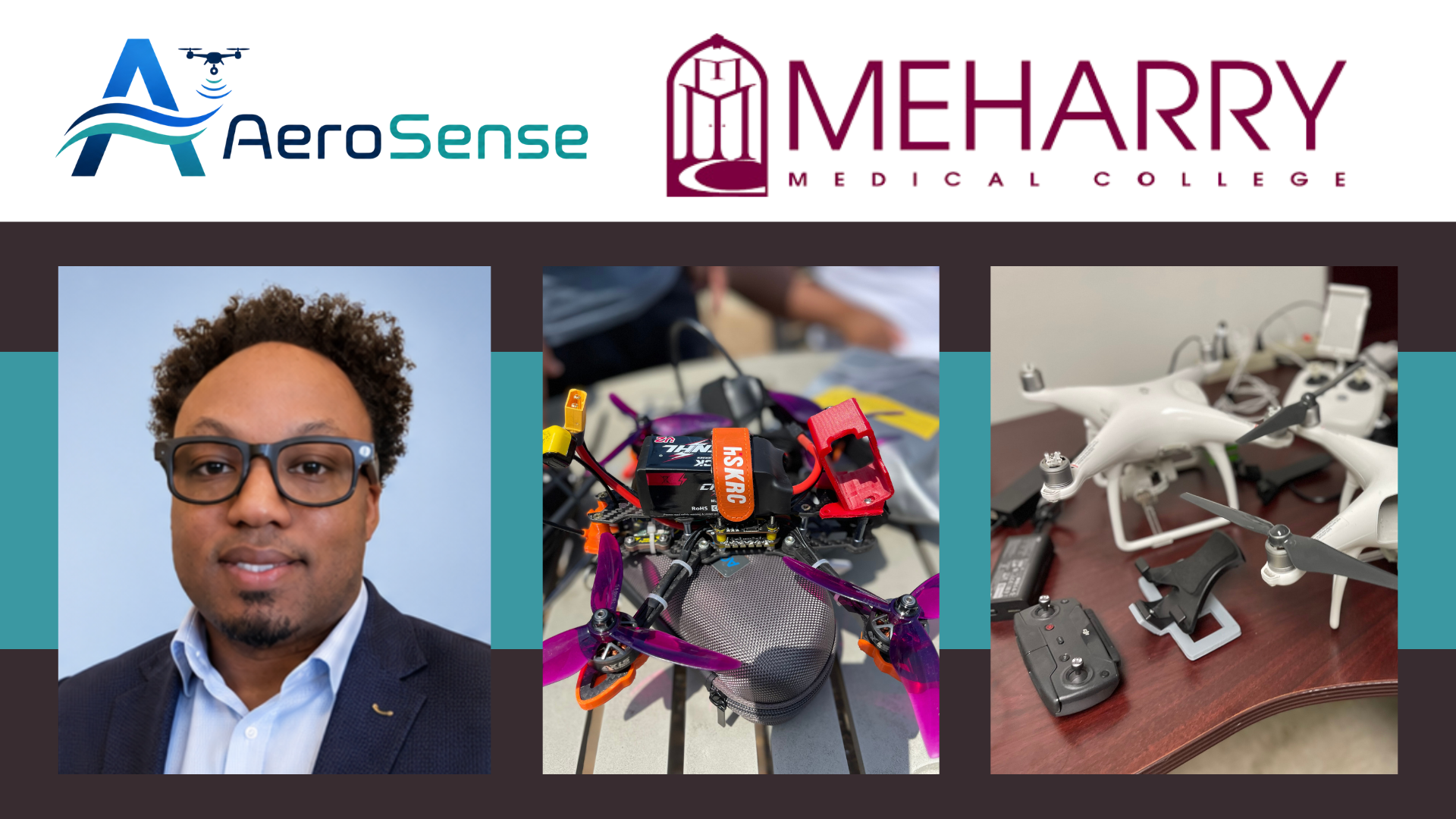
AeroSense was born out of Lockett's drone program at Meharry SACS, and originally inspired by his work with NASA. Working closely with Eugene Levin, Ph.D., principal investigator on a NASA Minority University Research and Education Project (MUREP) Precollege Summer Institute grant, Lockett translated Levin's data science and remote sensing expertise into student-friendly projects using VR/AR, mixed reality, and NASA datasets.
“It was exciting to see how David transformed NASA data science areas into engaging learning modules for high school students who do not have access to this content at their schools,” said Dr. Eugene Levin. “I am thrilled that he turned that experience into a potentially life-saving venture,” he adds.
The device enables first responders to assess chemical spills and gas leaks remotely, keeping humans at a safe distance while the drone documents hazardous environments. The product is currently in advanced prototype development.
A Nashville native and Fisk University alumnus, Lockett was selected as an Albert Einstein Distinguished Educator Fellow at NASA headquarters in Washington, D.C. before joining Meharry in 2021. He also holds a Master of Education in Educational Leadership from Lipscomb University.
In March 2026, AeroSense gained traction through the Mid-South I-Corps Hub Immersive cohort at South by Southwest (SXSW) in Austin, Texas, an experience Lockett said opened doors far beyond the conference walls. "I met astronauts, engineers, educators, and so many people working at the cutting edge of what I'm trying to build toward," he said. "It pushed me to think bigger about what AeroSense could become and how to share that opportunity with other innovators coming up behind me."
That momentum carried him to Demo Day, the culminating pitch competition of HBCUFI's eight-week Pre-Accelerator, the first and largest HBCU-centered pre-accelerator in the country. Founders who complete the program are expected to validate their idea and build a minimum viable product, which is then assessed through a live pitch before a panel of investors and entrepreneurs. Lockett advanced through a competitive breakout round before being named first-place winner among the Spring 2026 cohort, which drew students and alumni from more than 80 HBCUs nationwide.
"I was shocked," Lockett said of hearing the result. "I shared something I was passionate about and didn't expect anything. But they started asking questions about the business model and the next steps. Once I heard 'you're onto something here,' I realized maybe this could go somewhere."
With AeroSense moving forward, Lockett says the goal is simple: get the technology into the hands of first responders, federal agencies, and institutions working on the front lines of public safety. For him, the win is also a reminder of something he learned at NASA years ago. No idea is too crazy to bring to the table.
About AeroSense
AeroSense is a drone-mounted module that detects heat signatures from toxic gases at altitude, enabling remote hazard assessment during chemical spills and gas leaks. Developed using Meharry Medical College intellectual property, the product is currently in prototype development.
About HBCU Founders Initiative
HBCUFI supports and accelerates entrepreneurs affiliated with HBCUs through programming, mentorship, and funding competitions. Learn more at hbcufi.org.
About the NSF Mid-South I-Corps Hub Led by Vanderbilt University, the NSF Mid-South I-Corps Hub accelerates the translation of groundbreaking university research outcomes into commercialized ventures that seed emergent, prosperous innovation ecosystems across the region. The hub spans five states and includes 11 partner institutions: Vanderbilt University, University of Virginia, Jackson State University, George Mason University, Meharry Medical College, Tennessee State University, University of Louisville, University of Tennessee Knoxville, University of Memphis, University of Kentucky, and University of Arkansas. Learn more at midsouthhub.org.
Media Contact: lauren.carnahan@vanderbilt.edu