
University of Kentucky’s Hady Sabra Is Reimagining Alzheimer’s Risk Testing
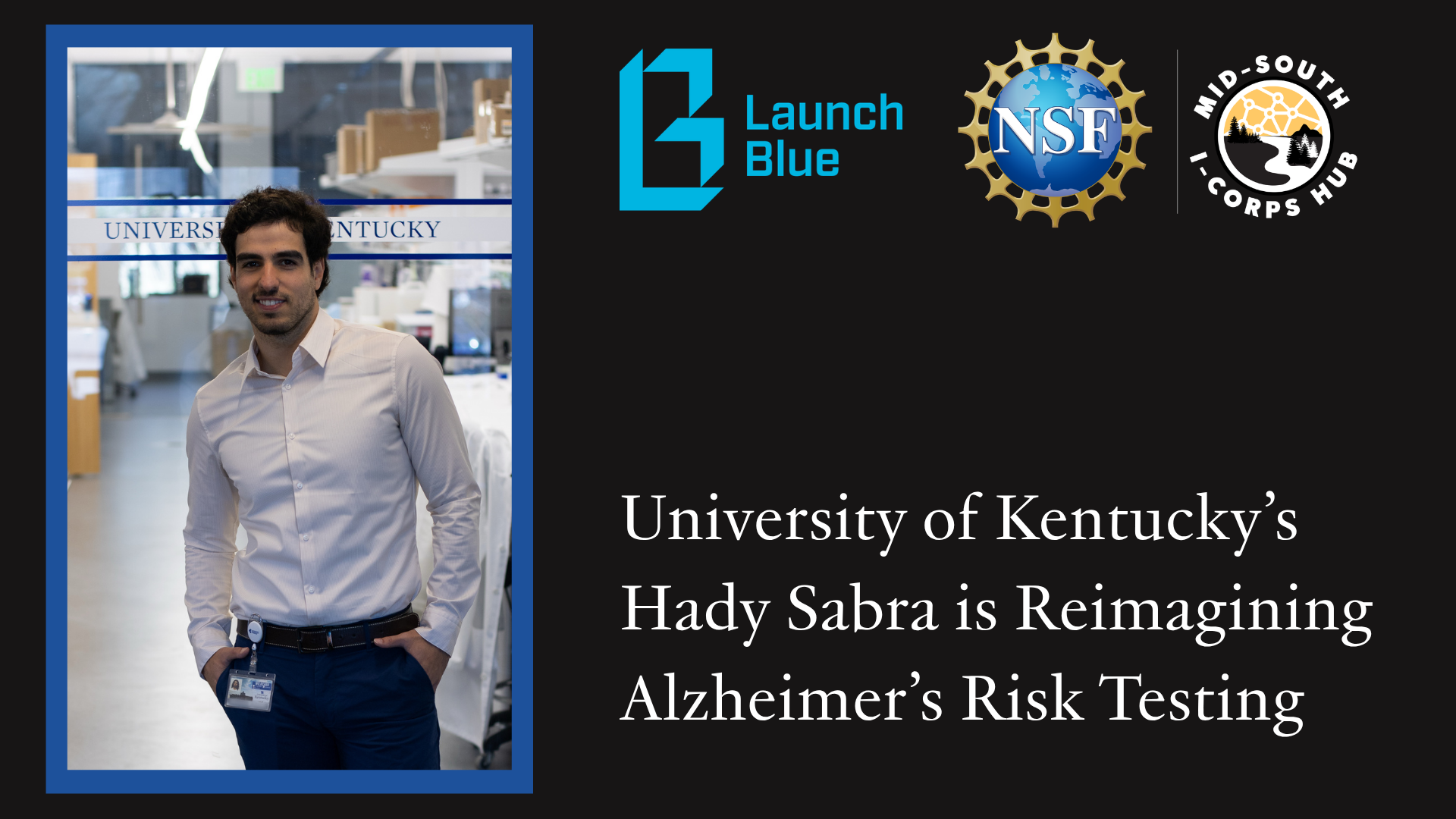
Anyone who has ridden a roller coaster knows the feeling right before the first drop. You’re strapped in, and as the ascent slows, the anticipation builds with every click of the chain lift. In line, you second guess whether to go through with it. Then that first drop hits, and it’s exhilarating. According to Hady Sabra, Ph.D. Candidate, University of Kentucky College of Medicine, that feeling is the perfect comparison to what it was like for him to pitch his Alzheimer’s research to a room full of judges. “You ride the roller coaster, and it’s frightening, but exciting,” he said. “And I want to do it again!”
Sabra knew early on that he belonged in science, but once he started college in Lebanon on a pre-med track, he realized his passion lay elsewhere. He was drawn to research, and to the idea of chasing questions no one had answered before. He also wanted to pursue those questions in America, forging his own version of the American dream.
“The United States is the land of opportunity,” he said. “You can come here and you can essentially ask literally any question that you might have, and the resources will be provided so that you can answer that question.” When the University of Kentucky offered him a Ph.D. scholarship, he didn't need much convincing. “You’re telling me you're going to let me explore my love of research?” he said. “That sounds like a dream.”
He arrived without a niche picked out. When potential mentors asked what he wanted to study, his answer was always the same: “I’m interested in doing research that is going to have an impact on people’s lives.” That search led him to an Alzheimer’s lab, where he has spent the past three years working on a disease that still has no cure.
Out of that work came the Phenotype Heritable Score, Sabra’s own alternative to the polygenic risk score, a widely used tool in genetic risk prediction. “The issue with polygenic risk scores and Alzheimer’s disease is that they don’t work, for a multitude of reasons,” he said. Rather than tune a model he felt didn’t work, he built his own, training it on the NIH’s Alzheimer’s Disease Sequencing Project to develop a genetic test. “You take this test and it will tell you if you’re going to get Alzheimer’s with very high accuracy,” he said. That knowledge could help patients seek out FDA-approved therapies or make lifestyle changes to delay onset. Sabra’s hope is that the test could one day become a standard part of clinical screening. “That would identify if you are at elevated risk to get Alzheimer’s disease, and allow you to take the proper intervention decision to at least delay or maybe even prevent Alzheimer’s from happening,” he said.
Getting a piece of research to that point takes more than good data. It also requires knowing how to explain your ideas and eventually build something around them. Sabra’s path there started with a seminar where he presented his early findings. Clinicians in the audience pulled him aside afterward and pointed him toward the UK Innovate’s Technology Commercialization team, which in turn informed him about Launch Blue’s regional National Science Foundation (NSF) I-Corps program. He had never heard of the NSF program before that conversation, and he applied just days before the deadline, with no expectations.
That first cohort, run through Launch Blue, reshaped how he thought about his own work. “It really changed the way that I look at science and my perspective of research in general,” he said. Much of that shift came from working closely with Executive Director of Launch Blue, Laura Halligan, who met with him one-on-one throughout the cohort, reviewing his business model canvas and giving feedback on his very first pitch deck. “It was an excellent experience, just five stars,” he said. “I’d recommend anyone who is interested in innovation or entrepreneurship to apply to the program, because it was just phenomenal.”
Halligan remembers that early mentorship the same way. “One of the best parts of this work is watching researchers evolve into entrepreneurs,” she said. “Hady has consistently approached commercialization with an open mind, a willingness to learn, and a commitment to understanding the people this technology is designed to serve. It’s been a privilege to support his journey.”
From there, he joined the Mid-South Hub’s Builder program after a conversation with Mark Hilton, program manager for the Vanderbilt Innovation Corps. Sabra said that cohort really advanced his overall understanding and sharpened his grasp of company formation and intellectual property to the point where he now considers himself an entrepreneur as much as a scientist. That momentum carried him to the Innovation Open Mic, a competitive pitching event offered by the Mid-South Hub. The pitch itself wasn’t perfect, according to Sabra. He ran over on time. But he calls it one of the best learning experiences of the whole process. “It was nerve-wracking but worth every second,” he said. “The kind of challenge I want to take on again and again.”
When asked what advice he’d give other researchers weighing a similar path, Sabra didn’t hesitate. “There’s going to be a lot of no’s,” he said. “There’s going to be a lot of closed doors, and the tip would be to have faith in your innovation and your technology and never give up. Keep knocking on that door, even if it’s closed, even if it’s a no, because at one point the door is going to open.”