
From Dentures to Discovery: Dr. Shruti Chhabra's Path to Better Implants
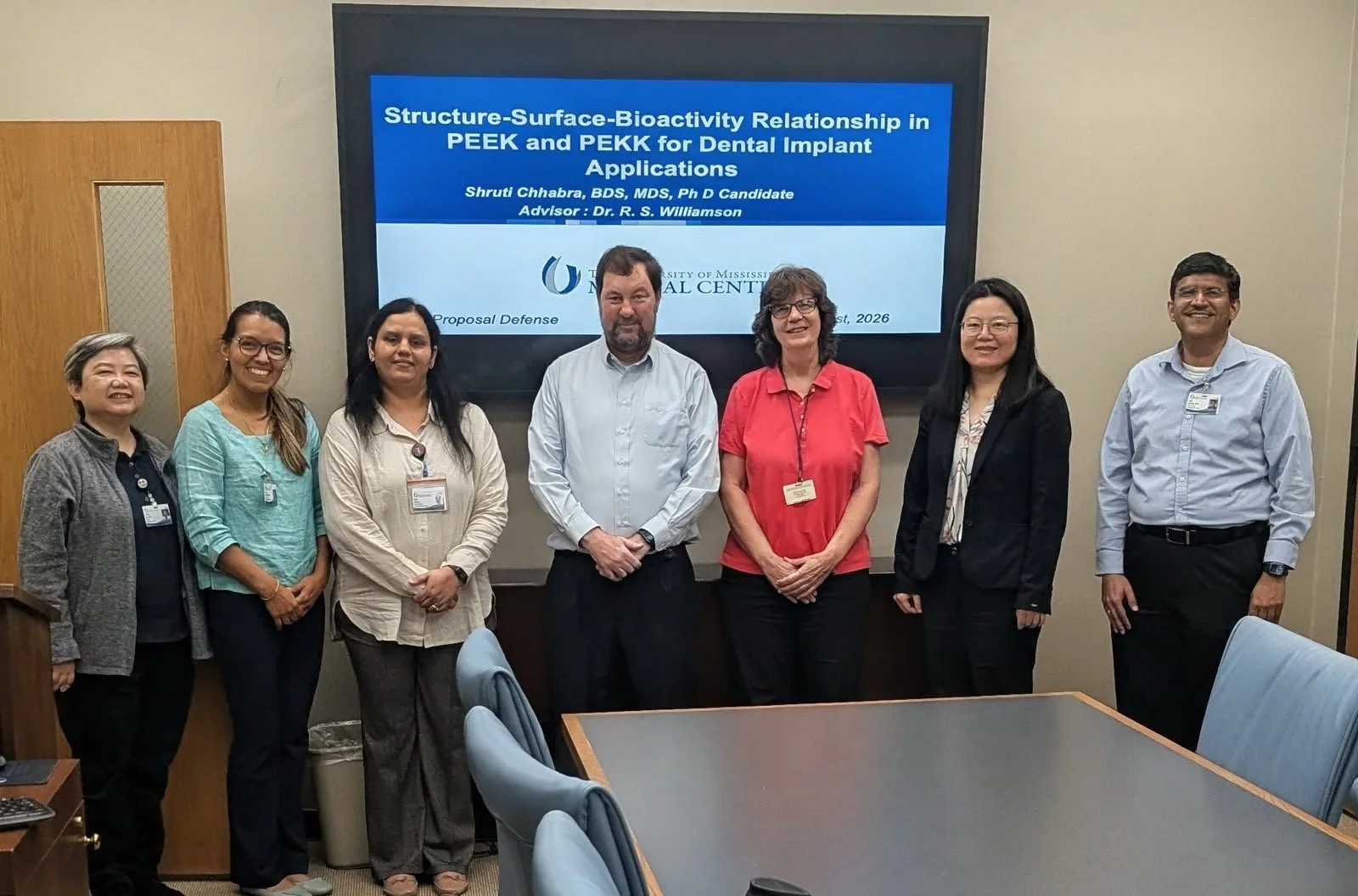
Dr. Shruti Chhabra is a Ph.D. Candidate in the School of Dentistry at the University of Mississippi Medical Center with more than 20 years of experience as an Oral and Maxillofacial surgeon. Her journey into dentistry began early, as her father was a practicing physician, and she watched her grandmother struggle with ill-fitting dentures for years. “I always used to think as a kid, how can I help my grandmother?” Chhabra said.
That early question stayed with her through years of clinical practice and eventually led to a potential improvement. According to Chhabra, titanium, a metal, has been the standard material for implants, and researchers have tried to enhance it with surface coatings designed to help implants bond with bone. Still, she saw firsthand how those coatings failed in practice. “The problem with the coatings is that many times when we are placing the implants into the patient’s mouth, they would come off,” she said.
These experiences left her wondering whether an entirely different implant material might solve the problem, leading her to conduct research during her Ph.D. program. “We are shifting from metallic implants to polymeric implants,” said Chhabra. “Polymer is a modified form of thermoplastic material that behaves more like bone.” However, developing a new material is only one part of the challenge. Chhabra knew that to bring it to market, the first step would be to convince patients and dentists to try something new.
Chhabra's introduction to the NSF Mid-South Hub I-Corps programming came at the Mississippi Academy of Science Conference in March 2026, where she attended a keynote by Latane Brackett. “I heard his keynote lecture and was very impressed. My PI, Dr. Scott Williamson, was there with me too, so I asked him if maybe I could join the course,” Chhabra said. She went on to join the Jackson State cohort, where she completed more than 20 customer discovery interviews.
Brackett’s mentorship pushed Chhabra to think beyond the science itself. “He was continuously challenging us to think beyond science and focus on understanding the needs of the end users through customer discovery,” she said. That guidance helped to shape her interviews. Rather than opening or pitching her own technology, she was encouraged to draw out people’s struggles with their current options. One common thread that emerged from her interviews was people’s concerns about the strength of polymeric implants. “Most of the customers that I was interviewing were concerned about the strength of the implant, because metal is definitely much stronger than plastic,” she noticed. That knowledge informed the decision to pivot in her research. “Maybe we need to reinforce our plastic with some carbon fibers or some glass fibers, so that the strength of the implant material is stronger,” she noted.
When considering next steps, Chhabra hopes to apply to the upcoming NSF National I-Corps program, where she will further develop her idea through an additional 100 customer discovery interviews. For Chhabra, the vision is to give patients and practitioners a better option one day. It is a goal that traces back to the same question she asked as a child, watching her grandmother struggle with a set of dentures that never quite fit. Decades later, as a surgeon and researcher, Chhabra is still working to answer it.