
University of Southern Mississippi Researcher's Conformable Pneumatics Aims to Reshape Impact Safety
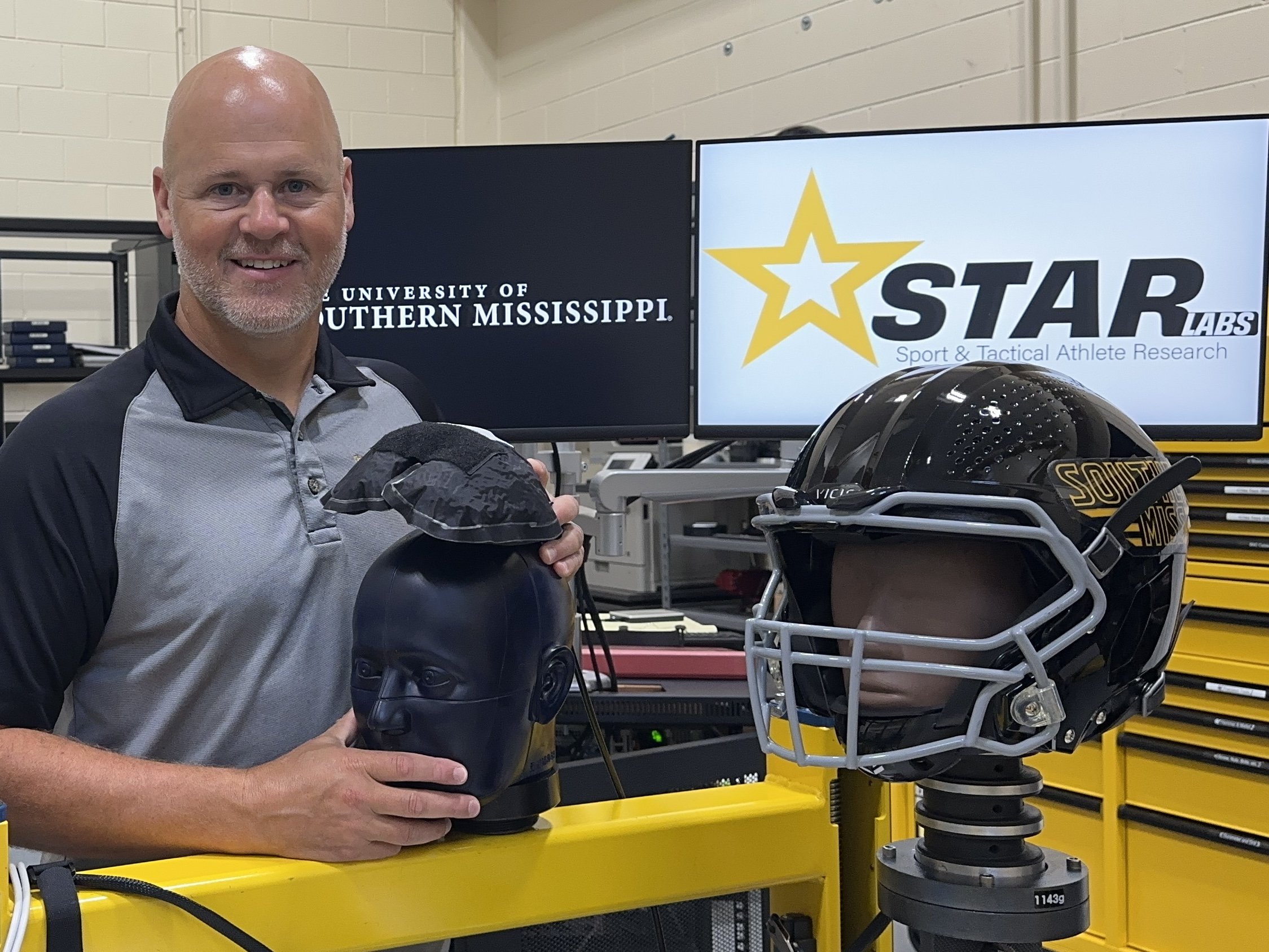
Dr. Scott Piland, professor in the School of Kinesiology and Nutrition and director of the Sport and Tactical Athlete Research (STAR) Lab at the University of Southern Mississippi (USM), is working on a novel padding system to improve how the body is protected from injury causing blunt impacts commonly experienced in both sport and tactical settings. His idea, called Conformable Pneumatics, grew out of decades of research on concussions and impact protection, and Piland is now exploring how to best commercialize it.
Piland began his career as a clinician caring for high school athletes on the sidelines. Seeing the need for better clinical tools he pursued his Ph.D. and began to engage in research on the brain injury of concussion. “The year I published my first paper there were only a handful of manuscripts being introduced into the scientific literature on this topic,” he said “Today we see thousands produced annually. This signifies the complexity of the problems being solved towards the mitigation of this problem.” As he grew his research endeavors, Piland identified a need to explore prevention over diagnosis. That early change in topic distinction led to the forming of STAR lab, and a $4.9 million Department of War (DOW) contract studying combat helmets, which pointed him to the padding problem he’s now trying to improve.
The concept of Conformable Pneumatics can be traced back to the fact that padding, regardless of where it is used on the body, needs not only to be functional, but wearable. According to Piland, many existing technologies have great function, but suffer from a severe lack of comfort, thus end-users do not adopt it. Drawing from his clinical experience and years of experience in the field, he has utilized several traditional technologies to form a unique approach that offers an energy absorbing system with an infinite capability to conform to the wearer. The goal is to offer padding systems which are the most comfortable on the market.
Piland’s team is working on proving the concept, and getting it to product form first, so it was imperative that they work on customer discovery. Guided by Dr. Brian Cuevas with the USM Office of Innovation Management, Dr. Piland was led to the NSF Mid-South Hub’s regional programming at Jackson State University. Piland completed 22 customer discovery interviews, under the mentorship of Innovation Program Manager, Latane Brackett, who Piland remarked was, “a major benefit to my program experience.” He went on to say, “Mr. Brackett, through his years of industry and manufacturing experience, brought clarity and precision to the process that fostered growth and understanding.”
A point gained from one-on-one office hours held with the course instructor was the importance of problem solving in a compassionate way. “You let people get to their own understanding, but you have to do that by asking good questions,” Piland said. “It’s easy for people to believe they already have a solution to stay focused inward, instead of listening outward. Real progress comes from understanding the problem the customer is facing and asking how the solution makes their life easier, not from assuming the solution speaks for itself.”
Piland is now preparing to apply for the NSF National I-Corps program. For him, the path forward is personal as well as professional. “Ultimately, I want to see people be safer,” he said. “Better safety decreases risk of injury, which results in better quality of life.” Piland sees a great purpose behind programs like I-Corps. “Manufacturing has largely disappeared from the United States”, he said. He believes ecosystems like the NSF and the Mid-South Hub can help to reverse that trend, by giving researchers a path to bring their ideas to life, instead of letting them sit unused. When Conformable Pneumatics moves from prototype to product, he wants it to stand as proof that research built in a university can find its way into the hands of people who need it, whether that’s an athlete on the field or soldier in the field.